



 yomi@rulecomposite.com



How to compare casting resin types for different manufacturing requirements
 Sep 29, 2026|
 View:23
Manufacturers and hobbyists face the same question at the start of every project. You must pick among epoxy, polyurethane, polyester, and silicone resins. Each family behaves differently in the mold, and your choice shapes the final part.
Which resin suits high-strength parts, flexible molds, or large-volume pours? The answer depends on your requirements, not on brand loyalty. Specialized products, such as Rule Composite's unsaturated polyester Casting Resin, deliver distinct benefits for specific jobs.
This guide matches resin properties with manufacturing needs. You will learn how hardness, cure speed, and cost separate these materials. That knowledge helps you choose with confidence.
Key Takeaways
Epoxy resin gives you strong, clear parts with low shrinkage. It works best for detailed and structural pieces.
Polyurethane resin is tough and resists impact. You can choose from soft to hard grades for flexible or rigid parts.
Polyester resin is a low-cost option that produces rigid parts. It handles heat well and suits automotive and industrial uses.
Silicone resin makes flexible molds that release complex shapes easily. It lasts for many cycles and resists high heat.
Test a small batch before you start a big project. This simple step saves time and money.
Epoxy Casting Resin
Properties and Advantages
Epoxy casting resin earns its reputation through three core traits: low shrinkage, strong adhesion, and excellent clarity. Traditional epoxy formulations typically undergo volumetric contraction during curing ranging from 2% to 5%. That low shrinkage keeps your mold dimensions accurate, so the finished part matches the design. Strong adhesion means the resin bonds well to inserts, fibers, and other substrates. High clarity lets light pass through with minimal distortion, which matters for display pieces and transparent parts.
These traits make epoxy a strong candidate for decorative items and structural components alike. You can cast paperweights, jewelry, and river tables with sharp visual detail. You can also produce structural parts that need to hold their shape under load. The material accepts pigments and additives well, so you control the final look without sacrificing mechanical performance.
Limitations and Common Uses
Standard epoxy generates heat as it cures. A thick pour traps that heat, and the buildup can crack the part or discolor the resin. For deep or large-scale pours, you should choose deep pour epoxy variants instead of standard formulas. These products manage exotherm and let you cast thicker sections in one step. Options include:
unuaST Deep Pour supports single pours up to 4 inches, cures in 48 hours to 85D hardness, and resists heat to 176°F.
Superclear Liquid Glass handles up to 4 inches per layer and delivers a rock-hard, food-safe finish.
TotalBoat Fathom pours 2-3 inches per layer with a 4-6 hour working time for complex embeds.
Deep pour epoxy suits large tabletops, countertops, and preservation work. Standard epoxy remains the better choice for thin castings, coatings, and small decorative pieces where heat cannot build up. Match the variant to your pour depth, and epoxy will serve you well as a casting resin for both art and engineering work.
Polyurethane Casting Resin
Properties and Advantages
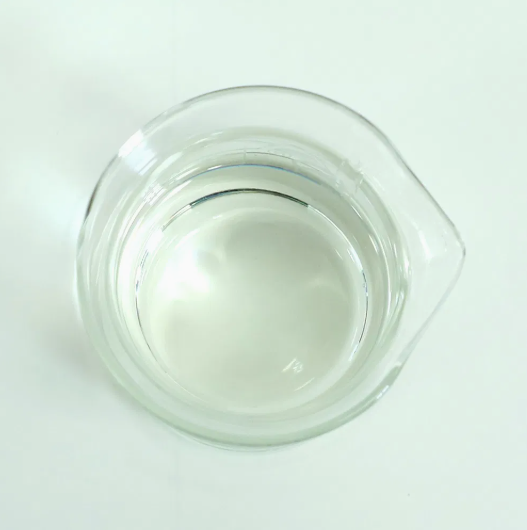
Polyurethane casting resin delivers unmatched toughness and impact resistance. You choose this material when your part must absorb shocks without cracking. That durability makes it ideal for components facing repeated stress or vibration.
The hardness range is remarkably wide. You can select a formulation as soft as 25 Shore OO, which feels like a marshmallow. Or you can pick a hard variant reaching 75 Shore D, comparable to a bowling ball. For example, Hei-Cast 8263 delivers 75-80 Shore D after post-curing. This versatility lets you match the exact flexibility or rigidity your project needs.
Modern tough 3D printing resins, like Tough 1000 and Tough 2000, share the same principle. They mimic polyurethane's durability for functional prototypes. These materials produce parts you can drop, bend, and test in real-world conditions.
Industries trust polyurethane for demanding applications. In aerospace, you find it in interior components and heat shields. Medical devices use it for catheters, tubing, and prosthetic limbs. Automotive engineers specify it for bumpers, suspension bushings, and gaskets. Electronics rely on it for protective casings that resist abrasion and impact. Each application exploits the material's ability to endure constant use without failing.
Limitations and Common Uses
Polyurethane does have drawbacks. You must control moisture during mixing. Even small amounts cause foaming or weak spots in the cured part. The resin also degrades under prolonged UV exposure. Outdoor parts need a protective coating or UV-stabilized formulation.
Cure time falls between epoxy and polyester. You get faster demolding than epoxy but less working time. Cost sits in the middle range among casting resin types. These factors matter when you plan production schedules.
These trade-offs make polyurethane best for interior functional prototypes and durable components. You use it for parts needing flexibility and repeated impact. Think of suspension bushings in a car or vibration isolators in avionics. It also suits gripper pads in robotics and wear liners in mining equipment.
For high-volume production or outdoor use, you might choose another option. But for tough, flexible, and impact-resistant parts, polyurethane delivers the performance you need.
Polyester Resin Applications
Properties and Advantages
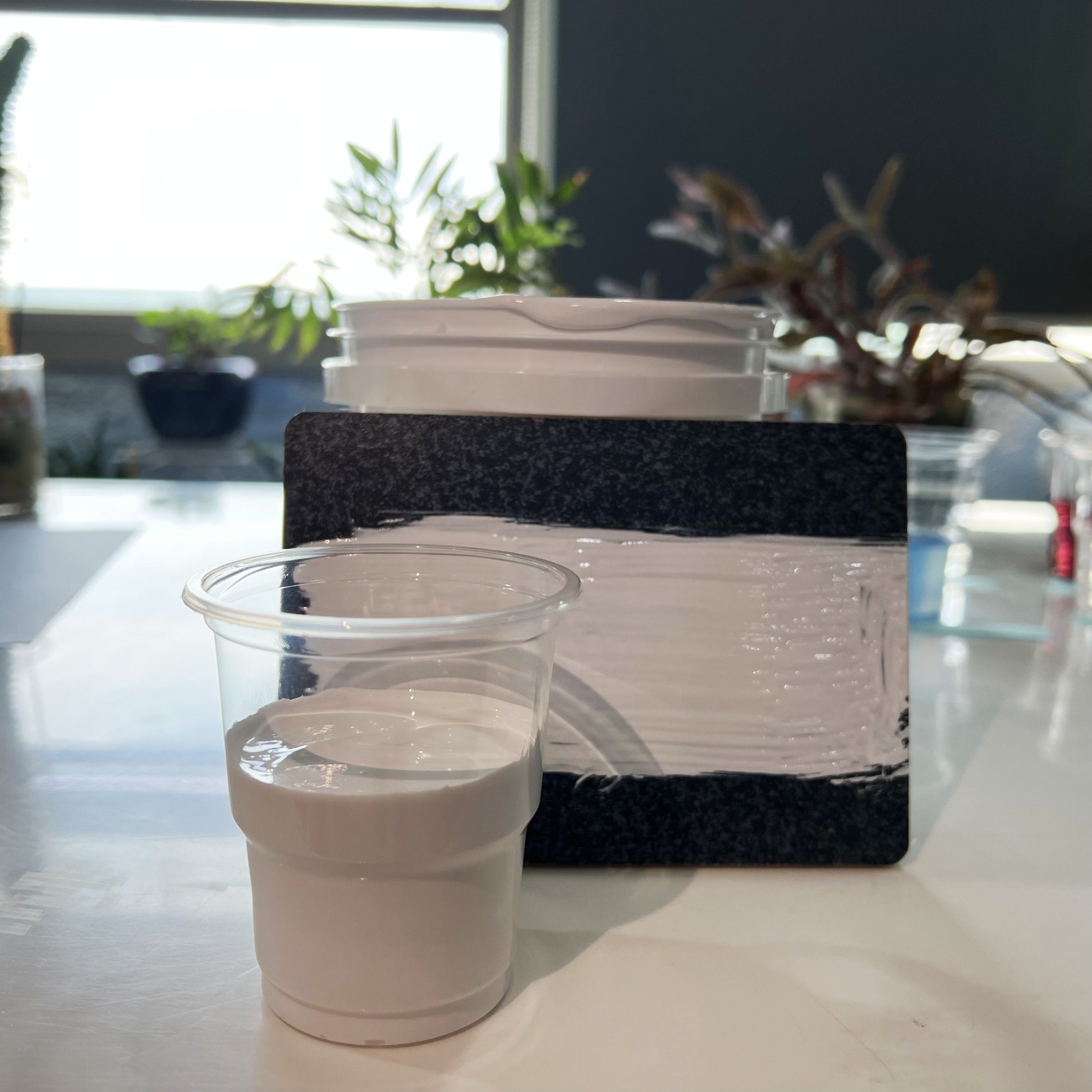
Polyester resin gives you a low-cost option with rigid results. Rule Composite's Casting Resin is an unsaturated polyester specifically engineered for casting applications. It delivers low shrinkage and high clarity, so your finished parts stay precise and visually appealing. The resin also offers excellent color stability and good mechanical strength. You get durable castings with consistent quality across every batch.
This material handles heat well in automotive settings. Its heat deflection temperature exceeds 120°C at 1.82 MPa, tested under ASTM D648. That rating means parts hold their shape under load at elevated temperatures. You can trust polyester for under-hood components and other warm environments.
Furfuryl resin variants also serve sand molds in 3D printing. These formulations share polyester's thermoset nature and provide strong mold integrity. You gain a reliable option for metal casting workflows.
Limitations and Common Uses
Polyester resin cures with noticeable shrinkage compared to epoxy. That shrinkage can pull parts away from mold walls or create surface imperfections. You should account for this in your mold design. The resin also produces styrene emissions during curing, so proper ventilation matters. These factors limit polyester in high-precision or enclosed production spaces.
Despite these limits, polyester serves many industries well. You find it in decorative items like figurines, plaques, and art pieces. Industrial components such as electrical housings and pump parts rely on its rigidity. Automotive applications include body panels, trim pieces, and structural brackets. Each use exploits the material's low cost and dependable strength.
Rule Composite's Casting Resin meets demands across art, electrical, and automotive sectors. The manufacturer ensures consistent quality and reliable supply. For projects needing a dependable unsaturated polyester casting resin, this product delivers outstanding performance.
Silicone Resin for Molds
Properties and Advantages
Silicone resin stands apart from other casting materials. You use it to make molds, not finished parts. Its flexibility lets you pull complex shapes from a mold without tearing the silicone or cracking the cast. Deep undercuts and delicate details release cleanly every time.
Heat resistance sets silicone apart. It withstands high temperatures that would destroy other mold materials. This trait makes it the top choice for vacuum casting and complex mold geometries. The material also resists sticking. You need no release agent in most cases, which saves time and reduces surface defects on your parts.
Durability varies by grade. A budget mold made from basic peroxide silicone lasts 200 to 500 cycles. Standard improved peroxide silicone pushes that range to 500 to 1,000 cycles. Professional-grade silicone, such as premium high-performance formulations, reaches 2,000 to 3,000 or more cycles.
Mould Category | Silicone Type | Lifespan (Cycles) |
|---|---|---|
Budget | Basic peroxide | 200–500 |
Standard | Improved peroxide | 500–1,000 |
Professional | Premium high-performance silicone | 2,000–3,000+ |
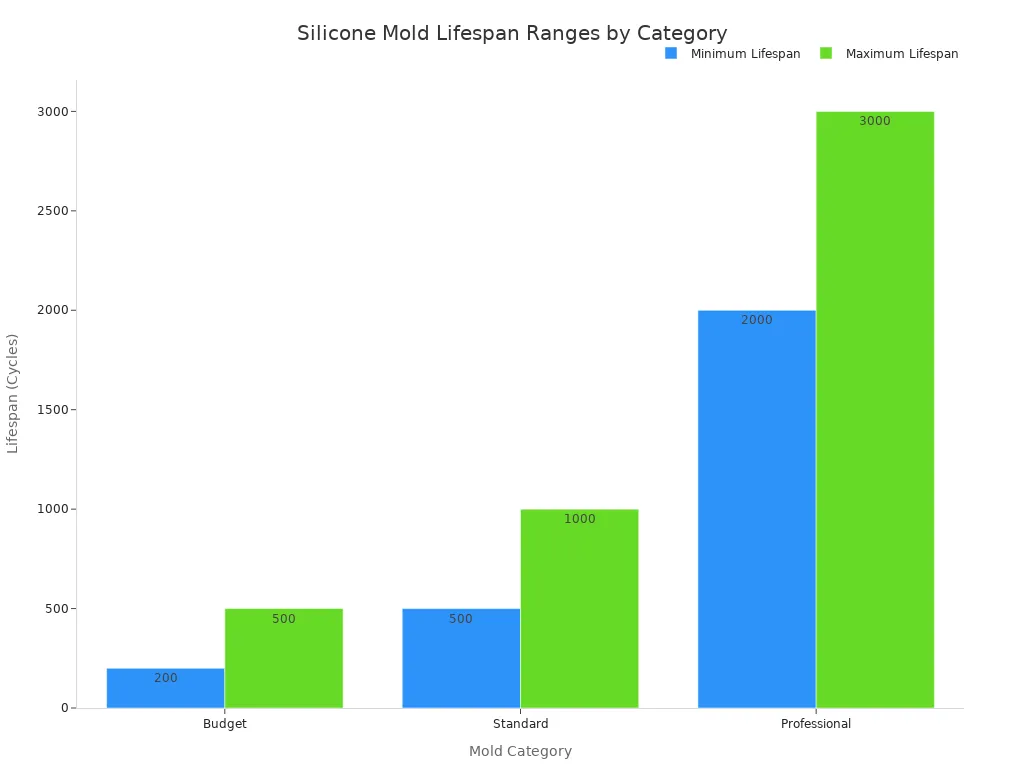
The lifespan of a silicone mould is not a fixed figure but the result of an equation combining material quality, usage conditions, and maintenance rigor. Between an entry-level mould that will fail after 200 bakes and a professional mould capable of exceeding 3,000 cycles, the gap represents a factor of 15.
Limitations and Common Uses
Silicone resin does not work as a structural material. You cannot cast a solid load-bearing part from it. The material lacks the stiffness and tensile strength you need for functional components. Instead, you use silicone as a mold material for other casting resin types. Epoxy, polyurethane, and polyester all pour into silicone molds.
Cost runs higher than other mold materials. You pay for flexibility and heat resistance. For short production runs, a cheaper mold material may serve you better. For long runs with complex geometry, silicone pays for itself through repeated use.
Care extends mold life. Extreme temperatures shorten the cycle count. Poor storage and rough handling do the same. Moderate use and careful maintenance push your mold toward the upper end of its rated range.
Resin Properties Comparison
You now have four material families and four different sets of strengths. The table below puts them side by side. Use it as a starting filter, then confirm the details with your supplier's data sheet.
Property | Epoxy | Polyurethane | Polyester | Silicone |
|---|---|---|---|---|
Hardness | Rigid to semi-flexible | 25 Shore OO to 75 Shore D | Rigid | Soft and elastic |
Tensile strength | High | High, with high elongation | Moderate | Low |
Temperature resistance | Moderate; deep pour grades reach 176°F | Moderate | Heat deflection above 120°C at 1.82 MPa (ASTM D648) | High |
Cure time | Slow, especially deep pour grades | Moderate | Moderate | Varies by grade |
Cost | High | Moderate | Low | High |
Shrinkage | 2% to 5% | Low to moderate | Noticeable | Not applicable |
Read the table by column, not by row. A single strong number rarely decides a project. You weigh several properties at once and accept a trade-off somewhere.
Start with the part itself. A clear decorative block points you toward epoxy. A bumper bushing that must flex and recover points you toward polyurethane. A rigid bracket produced in volume points you toward polyester. A mold for any of those parts points you toward silicone.
Next, check your process limits. Deep pours demand a slow cure and low exotherm, so deep pour epoxy variants fit pours up to 4 inches. Fast demolding favors polyurethane. High-volume runs favor polyester, because material cost drops and cure cycles stay predictable.
Finally, check the environment. Parts exposed to heat above 120°C need polyester or silicone. Outdoor parts need UV protection, which polyurethane lacks on its own. Silicone molds last 200 to 3,000 cycles depending on grade, so match mold quality to your run length.
Test a small batch before you commit. Mix a sample, cast it, and measure the result against your requirements. One afternoon of testing saves a ruined production mold.
Your choice comes down to trade-offs. Epoxy delivers high strength and fine detail. Polyurethane offers toughness and fast demolding. Polyester provides low cost and rigidity. Silicone excels at mold making and heat resistance.
Evaluate your production volume, the properties your parts need, and your budget. These three factors point you toward the right material.
For a reliable unsaturated polyester option, consider Rule Composite's Casting Resin. It delivers low shrinkage, high clarity, and consistent quality across batches.
Test a small batch before you commit to a large mold. One afternoon of testing protects your production schedule and your wallet.
FAQ
Which resin should you choose for a large, deep pour?
You need a deep pour epoxy variant for thick sections. Standard epoxy traps heat and can crack during curing. Deep pour formulas handle up to 4 inches per layer. They manage exotherm and protect your part from damage.
How do you pick between polyurethane and polyester for functional parts?
Polyurethane offers toughness and impact resistance. You select it for parts that flex and absorb shocks. Polyester provides rigidity at a lower cost. You choose it for stiff brackets and high-volume runs. Your part's stress profile decides the winner.
Why does silicone work as a mold material instead of a casting resin?
Silicone lacks the stiffness for load-bearing parts. You use it to make flexible molds that release complex shapes. It resists heat and sticking. Mold lifespan ranges from 200 cycles for budget grades to over 3,000 cycles for professional silicone.
What makes Rule Composite's Casting Resin a good choice for polyester projects?
Rule Composite's Casting Resin is an unsaturated polyester engineered for casting. It delivers low shrinkage and high clarity. The resin offers excellent color stability and good mechanical strength. You get consistent quality across batches for decorative, electrical, and automotive applications.
How do you test a resin before committing to a full production mold?
You mix a small batch and cast a sample part. Measure the result against your requirements for hardness, shrinkage, and clarity. One afternoon of testing protects your production schedule and your wallet. Never skip this step before a large pour.